
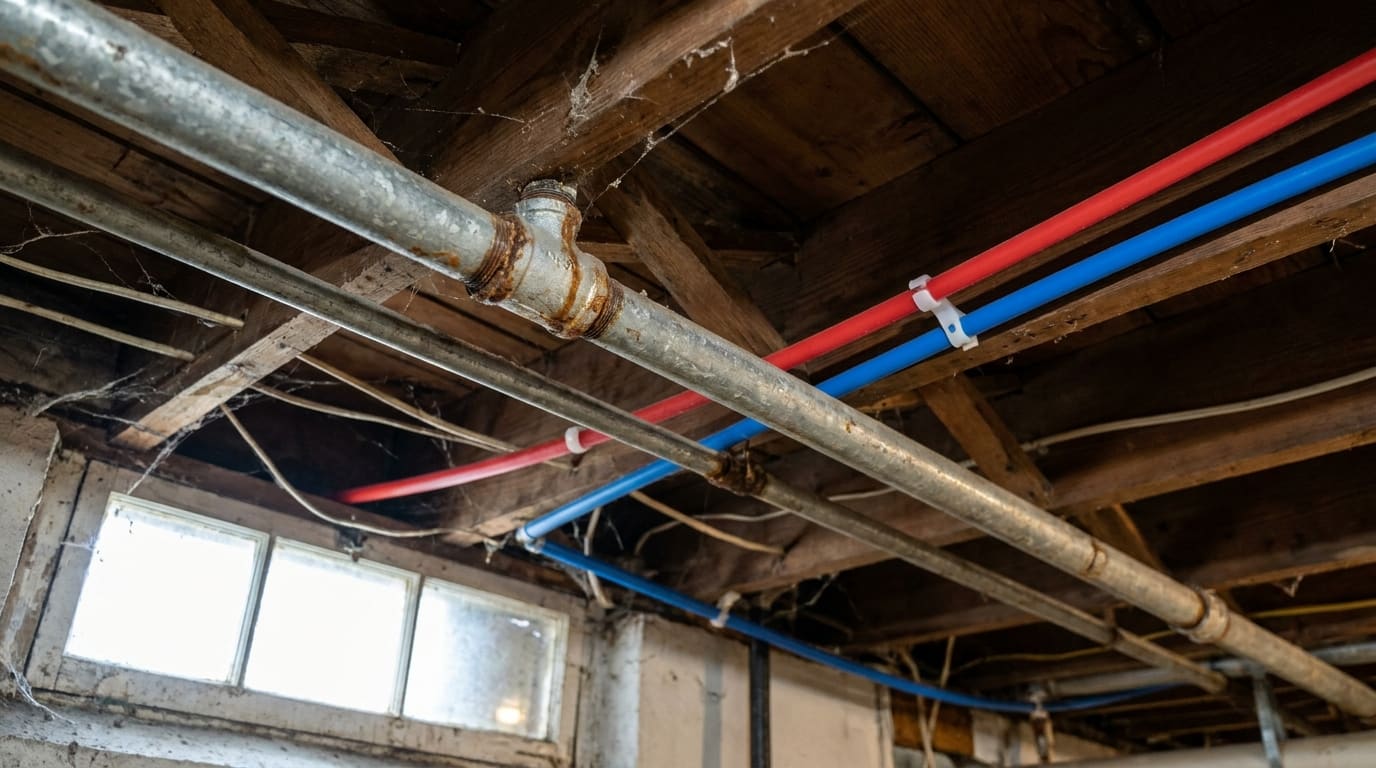
Rusty water at the first draw, pressure that drops whenever two fixtures run, or a new pinhole leak every few months: in an older house, these are often signs that the water supply pipes themselves are wearing out. Repiping means replacing a home’s water supply lines, usually with PEX or copper, either for the whole house or for the worst sections. Spokane Home Help connects callers with independent, local plumbing providers serving Spokane and nearby communities for repiping assessments, galvanized and polybutylene pipe replacement and recurring supply-line leaks.
What to Do Right Now
Leak right now? Shut off the water. Close the main shutoff valve, usually where the water line enters the basement or crawl space. Step-by-step help: How to Shut Off Your Main Water Valve. For a burst line, see What to Do When a Pipe Bursts.
Write down the symptoms. Which faucets are affected, hot side or cold side, what color the water is, and whether it clears after running. A plumber can narrow things down much faster with these details.
Look at the exposed pipe. Check near the main shutoff and the water heater. Dull gray, threaded metal pipe is often galvanized steel; flexible gray plastic stamped “PB2110” is polybutylene.
Watch for hidden leaks. Water stains, a musty smell or a jump in the water bill can point to a leak inside a wall or floor. See How to Check Your Home for a Hidden Water Leak.
Call a plumber if leaks keep showing up in different spots, pressure is low throughout the house, or the water stays discolored.
Sources: Washington L&I, City of Spokane, EBMUD, InterNACHI · Checked: November 7, 2026
In this guide: Warning signs · Older pipe materials in Spokane homes · PEX vs. copper · What a plumber typically does · What affects the cost · Permits · How the call works · Video · Common questions
Signs a House May Need Repiping
| Problem | What it usually means | How urgent |
|---|---|---|
| Rusty, brown or yellow water, especially at the first draw | Corrosion inside older galvanized steel pipes | Moderate – have the pipes checked |
| Low pressure at many fixtures, hot and cold | Scale and corrosion narrowing old supply lines | Moderate – usually gets worse over time |
| Low pressure at one faucet only | A clogged aerator, worn cartridge or a partly closed valve | Low – often a small repair, not a repipe |
| Repeated pinhole leaks or leaking fittings | Pipe walls or joints wearing out across the system | Moderate to high – more leaks are likely |
| Gray plastic supply pipe stamped “PB2110” | Polybutylene, a material with a history of failures | Moderate – plan an assessment |
| Water stains on ceilings or walls | A hidden supply-line leak | Soon – see leak detection |
| Water spraying from a pipe | A burst or split line | Urgent – shut off the main valve, see emergency plumber |
One leak does not always mean the whole house needs new pipes. A pattern of leaks, low pressure in many places and discolored water together are the stronger signal. If the problem is in the buried line between the meter and the house, see Water Line Repair in Spokane.
Older Pipe Materials Found in Spokane Homes
Neighborhoods such as the South Hill, Browne’s Addition and Hillyard include many homes that are several decades old. The pipe material matters, because each one ages differently.
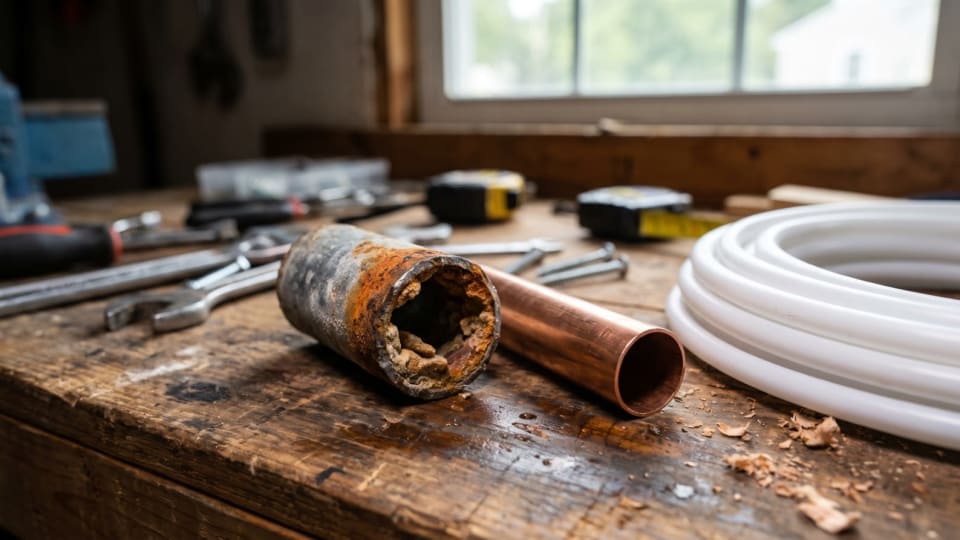
Galvanized steel. East Bay Municipal Utility District (EBMUD), a public water utility, explains that galvanized pipes were commonly used before the 1960s. Once the zinc coating is gone, the iron rusts, corrosion deposits build up inside the pipe, and the pipe eventually leaks. EBMUD notes that old, corroded galvanized pipes can cause low water pressure and discolored water. Source: EBMUD – Galvanized Iron Pipes · Checked: November 7, 2026
Galvanized pipe and lead. The City of Spokane says lead service lines were installed in the early to mid-1940s, when wartime shortages made other materials scarce, and that it completed a program to replace all remaining lead service lines in the City’s water system in July 2018. The City also sent EPA-required notices to about 1,000 property owners whose galvanized service lines could have been connected to a lead pipe before 2018; the EPA calls these “galvanized requiring replacement” lines. EBMUD adds that lead can be present in the coating of galvanized pipe, and that testing is the only way to know for sure whether a galvanized pipe is adding lead to the water. Source: City of Spokane – Lead Pipes; EBMUD – Galvanized Iron Pipes · Checked: November 7, 2026
Polybutylene. The International Association of Certified Home Inspectors (InterNACHI) reports that polybutylene was manufactured between 1978 and mid-1995 and installed in up to 10 million U.S. homes. It is most often gray, though it can also be white, silver, black or blue, and it is usually stamped with the code “PB2110”. InterNACHI explains that certain disinfectants in water can react with the material and cause small fractures that deepen over time, and that some homeowners with polybutylene face higher insurance premiums or trouble getting coverage. Source: InterNACHI – Polybutylene Pipes · Checked: November 7, 2026
PEX vs. Copper for Repiping
| Material | What it is | Questions to ask |
|---|---|---|
| PEX | Flexible plastic (cross-linked polyethylene) tubing, often color-coded red for hot and blue for cold. It can bend around corners and be pulled through walls in long runs. | Which type and fitting system will be used? How will the lines be routed and supported? Where will the manifold or connections be? |
| Copper | Rigid metal pipe joined with soldered or press fittings, used in homes for decades. | Which pipe type will be used? How many wall openings are needed to run rigid pipe? |
There is no single right answer for every house. The layout, how much wall and ceiling space is open, the existing pipe and the budget all play a part. Ask the plumber why they recommend one material over the other for this particular home.
What a Plumber Typically Does on a Repipe
| Step | What usually happens |
|---|---|
| 1. Assess | Identifies the existing pipe materials, checks pressure and looks for active leaks. Discusses whole-house versus partial repiping. |
| 2. Plan the route | Decides how new lines will run through the basement, crawl space, attic or walls, and where openings are needed. |
| 3. Permit | Applies for a permit where one is required. |
| 4. Install | Runs new supply lines to each fixture and connects them to the main line and the water heater. Water is usually shut off while connections are made. |
| 5. Test and inspect | Checks the new system for leaks under pressure, and arranges an inspection where the permit requires one. |
| 6. Close up | Patches access openings or leaves them for a drywall contractor, depending on what was agreed. |
What Affects the Cost of Repiping
- Size of the house: more bathrooms, fixtures and floors mean more pipe and more connections.
- Whole-house or partial: replacing only the worst sections is a smaller job than a complete repipe.
- Pipe material: PEX and copper differ in material and labor.
- Access: an open basement or crawl space is easier to work in than finished walls and ceilings.
- Main service line: whether the line from the meter to the house is included.
- Permits and inspections: fees vary by jurisdiction and scope.
- Wall repair: whether patching drywall and finishes is included or handled separately.
- What’s found: failing shutoff valves, water heater connections or hidden water damage can add to the job.
Ask for a written estimate that spells out exactly what is included, especially permits, wall patching and the main line.
Permits and Plumbing Rules in Spokane
Washington L&I states that only L&I-certified plumbers can legally perform plumbing work on someone else’s property, and that property owners can perform their own plumbing work on properties they own. The City of Spokane’s plumbing permit application covers residential remodel and repair work and asks applicants to identify all fixtures to be installed, moved, replaced and roughed-in. Whether a specific repipe needs a permit, and what the inspection covers, is a question for the plumber pulling the permit or the City’s permit staff. Homes outside Spokane city limits fall under a different permitting office. Source: Washington L&I – About the Plumber Certification Program; City of Spokane – Plumbing Permit Application (PDF) · Checked: November 7, 2026
How the Call Works
- Call and describe the problem – the age of the house, what pipe can be seen, where leaks have happened and how the water pressure and color look.
- The call is connected to an independent, local plumbing provider serving the area.
- Talk to the plumber directly. Ask about pipe options, permits and wall repair, ask for a written estimate, and decide whether to go ahead.
Before hiring: check Washington L&I contractor registration. The Washington State Department of Labor & Industries’ Verify tool shows whether a business has an active contractor registration and can confirm that a person doing plumbing work holds a Washington plumber certification. It also shows bond and workers’ comp information. Source: Washington L&I – Verify a Contractor, Tradesperson or Business · Checked: November 7, 2026
Video from Ask This Old House: a side-by-side look at PEX and copper water supply pipe:
Common Questions
Does the whole house have to be repiped at once?
Not always. Some homes have one problem area, such as a corroded run in the basement or the lines to one bathroom, and a partial repipe makes sense. If the remaining pipe is the same age and material, ask the plumber how likely it is to cause trouble next.
Is PEX or copper the better choice?
Both are widely used for home water supply. The right choice depends on the house layout, access to the walls and ceilings, the existing system and the budget. Ask the plumber to explain the trade-offs for this specific home.
Does polybutylene pipe have to be replaced?
InterNACHI notes that no regulation requires replacing it, though many plumbers recommend it and some homeowners with polybutylene face higher insurance premiums or lose coverage. It is worth checking with the home insurer. Source: InterNACHI · Checked: November 7, 2026
Can a homeowner repipe their own house in Washington?
Washington L&I says property owners can perform their own plumbing work on properties they own; work on someone else’s property requires an L&I-certified plumber. Permit and inspection requirements still apply, so check with the local permitting office first.
Areas served: Spokane neighborhoods including the South Hill, North Spokane, Hillyard, Browne’s Addition, Indian Trail and Five Mile Prairie, plus nearby Spokane Valley, Liberty Lake, Airway Heights, Cheney, Mead and Medical Lake.
Old Pipes in a Spokane Home?
One call connects to an independent, local plumbing provider serving Spokane and Spokane Valley for repiping assessments, galvanized and polybutylene pipe replacement and recurring leaks.
📞 Call Now – Connect With a Spokane Plumber
Spokane Home Help is a referral service, not a plumbing contractor.
Related Articles
- All repiping articles →
- Leak Detection in Spokane
- Water Line Repair in Spokane
- How to Check Your Home for a Hidden Water Leak
- How to Shut Off Your Main Water Valve
Spokane Home Help is a referral service and is not a plumbing contractor. Calls may be connected to an independent, third-party plumbing provider serving the caller’s area. Spokane Home Help does not perform plumbing work and is not responsible for the work, pricing, licensing or availability of any provider. Before work begins, confirm the provider’s Washington L&I registration and ask for a written estimate.