
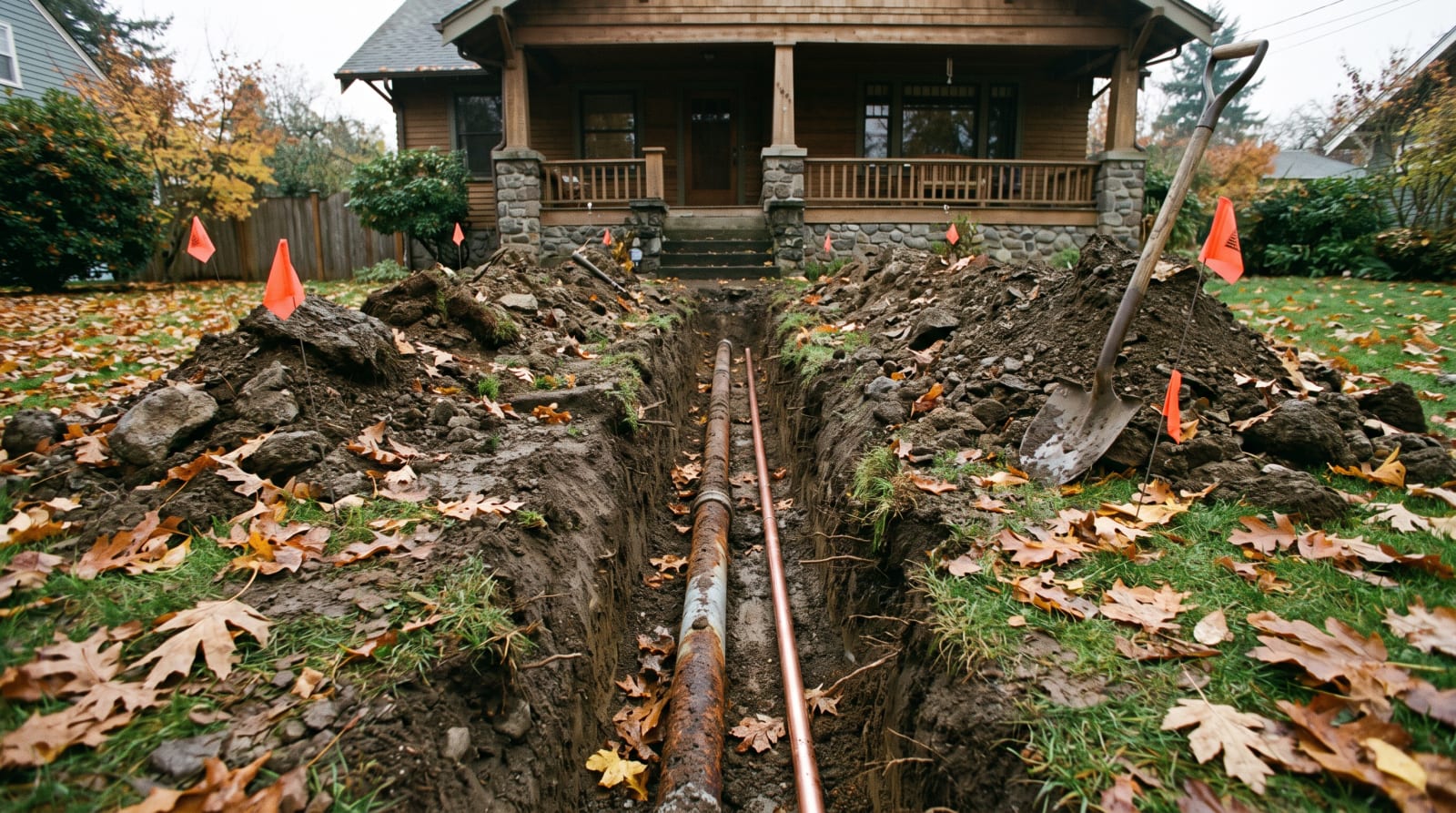
The Short Answer
A repair usually makes sense for one leak on a newer copper or polyethylene line that still delivers good pressure.
Replacement usually makes sense when the line is old galvanized steel or polybutylene, has leaked more than once, has lost pressure, freezes in cold snaps, or will end up under a new addition.
In the City of Spokane, either job needs a Water Repair/Replace permit and an inspection before the trench is covered, and new service lines are normally buried 5 feet deep.
Call a plumber once the meter shows a leak with every fixture off, the yard stays wet, or pressure drops throughout the house.
Sources: City of Spokane Water Department Rules and Regulations for Water Service · Checked: November 8, 2026
When the buried pipe between the water meter and the house starts leaking, most Spokane homeowners ask the same thing: patch the leak, or replace the whole line? The answer depends on the pipe’s material, age, depth and what sits on top of it. In older neighborhoods such as the South Hill, Hillyard and Browne’s Addition, many original service lines are galvanized steel that has been corroding from the inside for decades, and a patch on that kind of pipe often just moves the next leak a few feet down the line. For an overview of warning signs and how service calls work, see Water Line Repair in Spokane.
This guide walks through the decision step by step, from identifying the pipe to the City rules that shape the job.
In this guide: Who owns which part of the line · Identify the pipe material · When a repair makes sense · When replacement is the better call · Trench vs. trenchless · Spokane rules · What affects the cost · Choosing a plumber · Video · Common questions
First: Which Part of the Line Belongs to the Homeowner?
Before deciding anything, it helps to know whose pipe is leaking. For homes on City of Spokane water, the City installs the service materials from the water main to the right-of-way line. The meter box or vault, which is normally placed within about 3 feet of the closest property line, is owned and maintained by the property owner, along with all of the service line downstream of it. The rules also state that the City has no responsibility for the maintenance, operation or repair of a service connection, and that leaks past the first right-of-way or property line are the owner’s to repair. Source: City of Spokane – Water Department Rules and Regulations for Water Service (PDF) · Checked: November 8, 2026
Homes in Spokane Valley and other nearby areas are often served by separate water districts with their own rules; the provider named on the bill is the one to ask. City of Spokane customers can reach the Water Department at 509-625-7800.
Step 1: Identify What the Service Line Is Made Of
Pipe material is the single biggest factor in the repair-or-replace decision. The easiest place to see it is where the line comes through the basement floor or foundation wall, just before the main shutoff valve. The U.S. Environmental Protection Agency’s step-by-step guide uses nothing more than a coin or key and a magnet to help homeowners check their line. Source: U.S. EPA – Protect Your Tap: A Quick Check for Lead · Checked: November 8, 2026
| Material | How it usually looks | What it means for the decision |
|---|---|---|
| Galvanized steel | Dull gray, threaded joints; a magnet sticks firmly | Corrodes and narrows from inside; replacement is usually the long-term answer |
| Copper | Reddish-brown or penny-colored; a magnet does not stick | A single leak can often be repaired |
| Polyethylene (PE / HDPE) | Black or blue flexible plastic tubing | Approved by the City for new lines; isolated damage can often be repaired |
| Polybutylene | Gray, sometimes blue or black, plastic with crimped fittings | Can turn brittle with age; many owners choose replacement |
| Lead | Dull gray, soft; scratches to a shiny silver; a magnet does not stick | Should be replaced (see below) |
About lead and “galvanized requiring replacement” lines in Spokane: The City of Spokane reports that it replaced its last remaining lead service lines by July 2018 and has no lead pipes left in its water system. Because some galvanized service lines were once connected to lead pipe and may have absorbed lead, the EPA required the City to notify roughly 1,000 property owners; the EPA calls these lines “galvanized requiring replacement.” An owner who received that notice already has the answer. The EPA notes that testing drinking water through a certified lab is the only way to confirm whether lead is present. Sources: City of Spokane – Lead Pipes; U.S. EPA · Checked: November 8, 2026
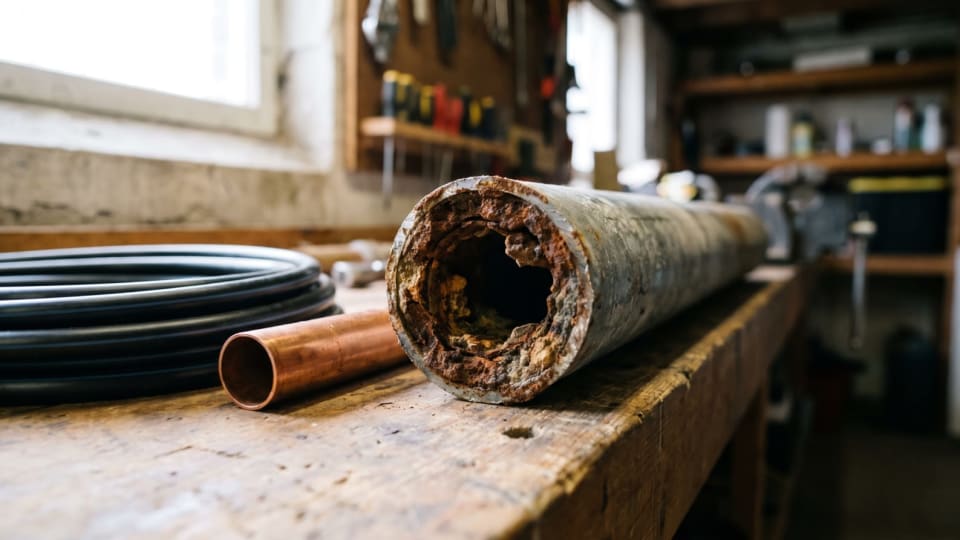
When a Repair Makes Sense
A spot repair means digging to the leak and replacing the damaged section. It is usually reasonable when:
- The line is copper or polyethylene and in otherwise good shape.
- There is one leak with a clear cause, such as a fence post, a tree root or a single freeze.
- Water pressure is still good at every faucet.
- The leak is easy to reach, not under a driveway or retaining wall.
The City’s rules allow repairs to be made with like materials and accept brazed connections for repairing underground copper services. They also say galvanized fittings must not be directly buried, which matters when an older line is being patched. Source: City of Spokane – Water Department Rules and Regulations for Water Service · Checked: November 8, 2026
When Replacement Is the Better Call
In these situations a repair tends to be money spent twice:
| Situation | Usually points to | Why |
|---|---|---|
| Galvanized line with weak pressure at every tap | Replacement | Internal rust has narrowed the whole pipe, not just one spot |
| Second or third leak on the same line | Replacement | Repeated leaks signal the pipe is failing along its length |
| Polybutylene service line | Replacement (often) | Brittle pipe and fittings make further leaks likely |
| “Galvanized requiring replacement” notice from the City | Replacement | The line may have absorbed lead from a former connection |
| Line freezes in hard cold snaps | Replacement or relay deeper | The line is likely too shallow; the City’s standard depth is 5 feet |
| Planned addition, garage or ADU over the line | Relay or sleeve | City rules require a sleeve or a relay at least 10 feet from the outer foundation wall |
| Sewer line being replaced in the same yard | Consider both together | One excavation, and required separation can be planned |
Source: City of Spokane – Water Department Rules and Regulations for Water Service; City of Spokane – Lead Pipes · Checked: November 8, 2026
If every faucet has slowly lost force over the years and the indoor pipes are already updated, the narrowing is likely in the buried line. If the indoor plumbing is also galvanized, a whole-house repipe can be planned alongside the service line. To rule out a running toilet or another indoor leak first, use the meter test in How to Check Your Home for a Hidden Water Leak.
Replacement Methods: Open Trench vs. Trenchless
Open trench. A trench runs from the meter to the house and new pipe is laid on proper bedding. It works in nearly any soil and lets the inspector see the whole line, at the cost of torn-up lawn and beds.
Trenchless (pulling or bursting). New pipe is pulled through the path of the old one between small pits at each end, sometimes splitting the old pipe as it goes. It suits fairly straight lines under driveways or mature landscaping.
Trenchless (directional boring). A new underground path is drilled between two pits and the line is pulled back through it. Other buried utilities and rocky ground can limit it.
Either way, the new line must meet the City’s depth and material rules, and both ends still need excavation.
Spokane Rules That Shape a Water Line Job
- Permit: Repairing or replacing an existing service requires a Water Repair/Replace permit. A permit fee applies; check with the City for current fees.
- Inspection before backfill: Work from the property line to the main shutoff valve inside the building must be inspected before it is covered, with 48 hours’ notice.
- Depth: Services are to be 5 feet deep from finished grade. An existing service may be relaid only if at least 4½ feet of depth and 5 feet of separation from the sewer can be kept.
- Materials on private property: For 1-inch to 2-inch services, seamless soft Type K copper or HDPE (with steel stiffeners and approved joints). HDPE lines need tracer wire so they can be located later.
- At the house: no joints under the floor or within 5 feet of the outer wall.
- High pressure: Where pressure on a 2-inch or smaller service is 80 PSI or higher, a pressure-reducing valve is required inside the building.
- Excavation safety: Trenches must be sloped, shored or benched to Washington L&I standards (WAC 296-155 Part N).
Source: City of Spokane – Water Department Rules and Regulations for Water Service · Checked: November 8, 2026
What Affects the Cost of Repair vs. Replacement
The main factors behind an estimate:
- Scope: one repair pit versus the full run from meter to house.
- Length and depth: a long run at the City’s 5-foot depth means more excavation.
- What is on top: driveways, sidewalks, retaining walls and mature trees steer the choice between trench and trenchless.
- Soil: rocky ground is slower to dig and can rule out some trenchless methods.
- Extras: a new main shutoff valve, pressure-reducing valve or meter box.
- Permit, inspection and restoration: a permit fee applies, and lawn or concrete repair is often quoted separately.
A repair is usually the smaller bill today, but repeated repairs on a failing galvanized line can add up past one replacement. A written, itemized estimate is the only reliable figure.
Choosing and Verifying a Plumber for the Job
The Washington State Department of Labor & Industries’ Verify tool shows whether a business has an active contractor registration, whether a person holds a Washington plumber certification, and bond and workers’ comp information. Source: Washington L&I – Verify a Contractor, Tradesperson or Business · Checked: November 8, 2026
When comparing estimates, compare the plans too: one may be a spot repair, the other a full replacement at proper depth. If water is pooling in the yard, shutting off the water comes first. See How to Shut Off the Main Water Valve and, for urgent situations, Emergency Plumber in Spokane.
Video from This Old House: replacing old water and sewer lines between the street and the house, including the trench and the new connections:
Common Questions
Should a leaking main water line be repaired or replaced?
One leak on a newer copper or polyethylene line is usually a repair. An old galvanized or polybutylene line, or one with repeated leaks or fading pressure, is usually better replaced, because the next leak is likely elsewhere on the same pipe.
Is trenchless water line replacement worth it?
It can be when the line runs under a driveway or mature landscaping that would be costly to restore. In open lawn, a trench is often simpler. Route, soil and other utilities decide whether trenchless is possible.
What pipe is used for a new water service line in Spokane?
For typical 1-inch to 2-inch residential services on City of Spokane water, the rules list seamless soft Type K copper or HDPE polyethylene with steel stiffeners, plus tracer wire on HDPE so the line can be found later. Other water districts may have different lists, so check with the provider on the bill.
How deep should a water line be buried in Spokane?
The City’s standard is 5 feet below finished grade, including where the line enters the building. A line that freezes in cold snaps is often too shallow, a strong reason to relay rather than patch it.
Does homeowners insurance cover a broken water service line?
Policies vary. The policy and the insurance agent are the places to check, ideally before work starts, including whether buried service lines are covered. Photos of the leak and excavation help with any claim.
Can a homeowner replace their own water line in Spokane?
The City requires a permit, inspection before backfill, approved materials, 5-foot depth and a trench meeting L&I safety standards. Given the depth and safety rules, most owners hire a plumber; anyone considering DIY should call the Water Department first.
Quick Summary
- On City of Spokane water, the line from the meter box to the house is the owner’s responsibility.
- Identify the pipe material first: galvanized and polybutylene usually point to replacement; copper and HDPE often allow a repair.
- Repeated leaks, falling pressure, a “galvanized requiring replacement” notice or a line that freezes all favor replacement.
- Trenchless methods help under driveways and landscaping, but route and soil decide.
- City rules: permit, inspection before backfill, 5-foot depth, Type K copper or HDPE.
- Call 811 before digging, and get a written, itemized estimate.
Repair or Replace Your Water Line?
One call connects to an independent, local plumbing provider serving Spokane and Spokane Valley for leaking, aging and broken water service lines.
📞 Call Now – Talk to a Spokane Plumber
Spokane Home Help is a referral service, not a plumbing contractor.
Related Articles
- Water Line Repair in Spokane
- Printable Spokane Winter Plumbing Checklist (PDF)
- How to Check Your Home for a Hidden Water Leak
- Repiping in Spokane
Spokane Home Help is a referral service and is not a plumbing contractor. Calls may be connected to an independent, third-party plumbing provider serving the caller’s area. Spokane Home Help does not perform plumbing work and is not responsible for the work, pricing, licensing or availability of any provider. Before work begins, confirm the provider’s Washington L&I registration and ask for a written estimate.