
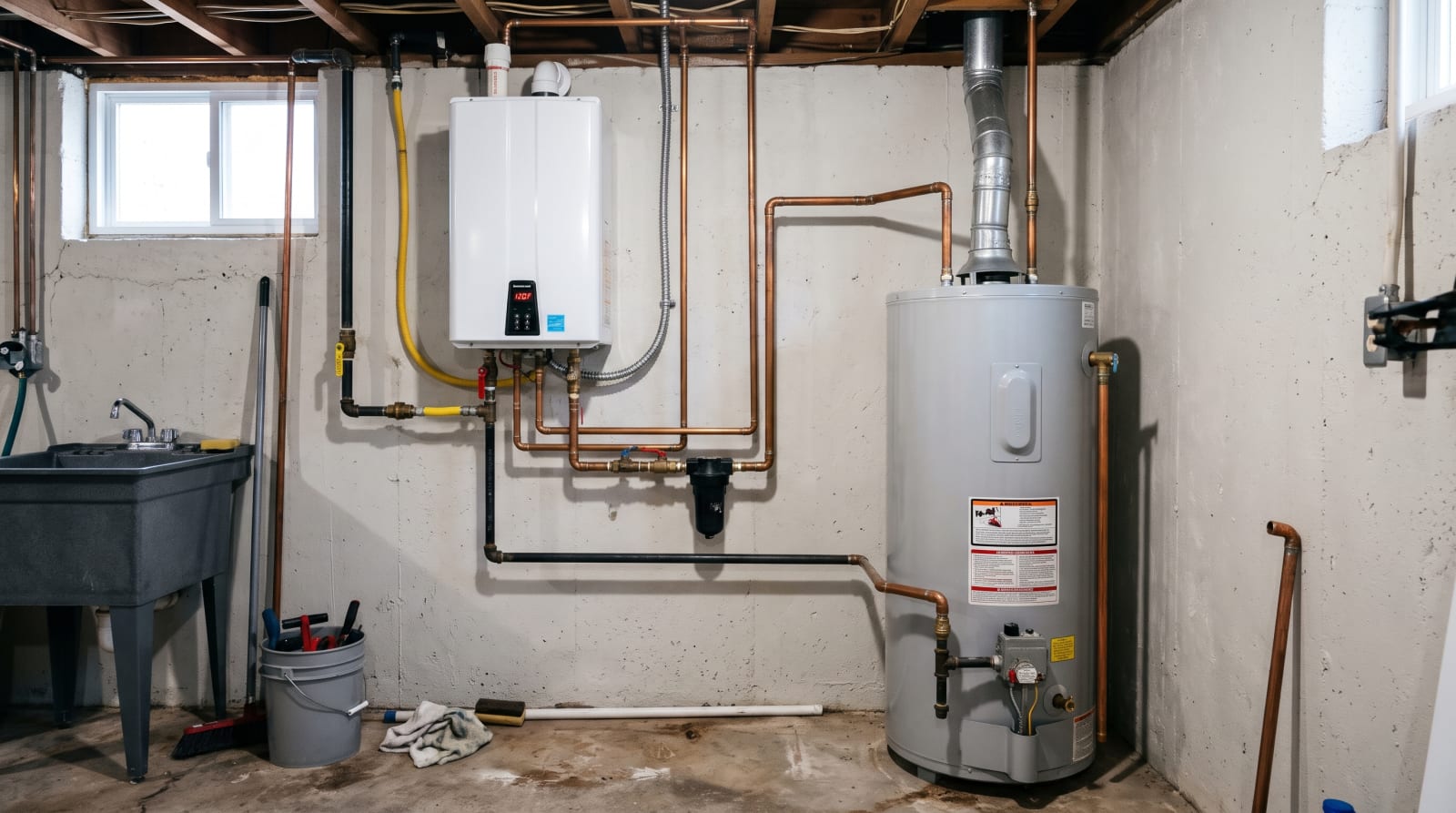
The Short Answer
Tank: keeps 20–80 gallons hot and ready, costs less upfront, but loses heat around the clock (standby loss) and typically lasts 10–15 years.
Tankless: heats water only when a tap opens, typically delivers 2–5 gallons per minute, often lasts more than 20 years, and can be 24–34% more efficient in lower-use homes, but costs more upfront.
Spokane winters: the colder the incoming water, the bigger the temperature rise a tankless unit must deliver and the fewer gallons per minute it can supply. Size it for winter water, not summer water.
Third option: a heat pump water heater can be two to three times more efficient than a standard electric tank, but needs a space that stays between 40°F and 90°F year-round.
Sources: U.S. Department of Energy (Energy Saver, Better Buildings) · Checked: November 7, 2026
When a water heater fails in Spokane, the replacement decision usually has to be made quickly, often in the middle of winter. The two main choices are a traditional storage tank and a tankless (on-demand) unit, with heat pump water heaters as a third path for homes with the right space. Each one handles cold incoming water, simultaneous showers and long-term operating costs differently. This guide compares them using U.S. Department of Energy guidance, explains why Spokane’s cold winter water matters so much for tankless sizing, and outlines when each type tends to make sense.
In this guide: How a tank works · How tankless works · Side-by-side comparison · The Spokane factor: cold incoming water · When a tank makes sense · When tankless makes sense · Heat pump water heaters · Video · Common questions
How a Tank Water Heater Works
A conventional storage water heater keeps a reservoir of water hot at all times. When a hot tap opens, hot water leaves from the top of the tank and cold water enters at the bottom through a dip tube, so the tank always stays full. Tanks for single-family homes hold between 20 and 80 gallons and run on natural gas, propane, fuel oil or electricity. Because the water is held at the thermostat setting even when nobody is using it, heat escapes into the surrounding air. The Department of Energy calls this standby heat loss and notes that tanks insulated to R-24 or higher lose less. Source: U.S. Department of Energy – Storage Water Heaters · Checked: November 7, 2026
A tank is sized by its first hour rating: the number of gallons it can supply in one hour, starting full. Energy.gov recommends a model whose first hour rating is at least equal to the household’s busiest hour of hot water use. Its example of three showers, a shave and hand-washed dishes adds up to 66 gallons. The rating appears on the EnergyGuide label as “Capacity (first hour rating).” Source: U.S. Department of Energy – Sizing a New Water Heater · Checked: November 7, 2026
How a Tankless Water Heater Works
A tankless unit has no storage tank. When a hot tap opens, cold water travels through a heat exchanger where a gas burner or electric element heats it on the spot. According to the Department of Energy, typical units deliver about 2–5 gallons per minute, and gas models generally reach higher flow rates than electric ones. Since nothing sits in a tank, tankless units avoid standby heat loss. One exception: a gas model with a standing pilot light can waste enough energy to cancel part of that advantage, so models with intermittent ignition are the more efficient choice. Source: U.S. Department of Energy – Tankless or Demand-Type Water Heaters · Checked: November 7, 2026

Tank vs. Tankless: Side-by-Side
| Tank (storage) | Tankless (on-demand) | |
|---|---|---|
| How hot water is supplied | From a stored reservoir of 20–80 gallons | Heated as it flows, about 2–5 gallons per minute |
| Sized by | First hour rating vs. busiest hour of use | Flow rate at the required temperature rise |
| Standby heat loss | Yes, water is kept hot all day | Avoided (except gas models with a standing pilot) |
| Efficiency vs. a storage tank | Baseline | 24–34% more efficient at 41 gallons/day or less; 8–14% at about 86 gallons/day |
| Typical lifespan | 10–15 years | More than 20 years |
| Upfront cost | Lower | Higher, partly offset over time by lower operating costs |
| Several taps at once | Limited by stored volume | Can exceed a single unit’s capacity |
Source: U.S. Department of Energy – Tankless or Demand-Type Water Heaters; Storage Water Heaters; Sizing a New Water Heater · Checked: November 7, 2026
The Spokane Factor: Cold Incoming Water in Winter
Tankless units are rated by the maximum temperature rise they can produce at a given flow rate. Temperature rise is the desired output temperature minus the temperature of the water coming into the house. Energy.gov’s sizing example assumes 50°F incoming water “unless you know otherwise” and a 120°F output for most uses, which means a 70°F rise. At that rise, it says gas units can commonly deliver about 5 gallons per minute and electric units about 2. Source: U.S. Department of Energy – Sizing a New Water Heater · Checked: November 7, 2026
Here is why that matters in Spokane. The colder the incoming water in January, the larger the rise the unit has to produce, and the fewer gallons per minute it can deliver at the target temperature. A unit that comfortably runs a shower and a faucet in September may fall short when the incoming water is at its coldest. Energy.gov’s own example of a faucet (0.75 gallons per minute) plus a shower (2.5 gallons per minute) already needs at least 3.25 gallons per minute. When getting a tankless quote, ask the installer what incoming water temperature the sizing is based on, and make sure it reflects winter conditions rather than an annual average.
When a Tank Makes Sense
- Upfront cost is the main concern. Energy.gov notes that tankless units cost more initially than storage heaters.
- Several hot water uses often run at once. A shower plus a dishwasher can exceed the capacity of a single tankless unit, even a large gas model. The fix is a second unit, which adds cost.
- The household’s busiest hour fits within a tank’s first hour rating. If a standard tank already covers peak use, there may be little practical benefit to switching.
- The home has only electric service and the winter flow rate an electric tankless unit can deliver (about 2 gallons per minute at a 70°F rise) would not cover the household’s needs.
When Tankless Makes Sense
- Daily hot water use is moderate. The efficiency advantage is largest (24–34%) in homes using 41 gallons a day or less.
- The plan is to stay in the home for many years. A lifespan of more than 20 years and lower operating costs can offset the higher purchase price over time.
- Floor space is tight. There is no storage tank to house.
- The unit can be sized for winter water. A gas model with intermittent ignition, sized for Spokane’s coldest incoming water, helps avoid lukewarm showers in January.
Source: U.S. Department of Energy – Tankless or Demand-Type Water Heaters · Checked: November 7, 2026
A Third Option: Heat Pump Water Heaters
A heat pump water heater (sometimes called a hybrid) is an electric tank that moves heat from the surrounding air into the water instead of generating heat directly. The Department of Energy says these units can be two to three times more energy efficient than conventional electric resistance water heaters. They come with a built-in tank and backup electric elements. Source: U.S. Department of Energy – Heat Pump Water Heaters (Energy Basics) · Checked: November 7, 2026
Placement is the key question for a Spokane home. DOE guidance says a heat pump water heater needs a location that stays between 40°F and 90°F year-round, with at least 1,000 cubic feet of air space around it. The units tend to cool the space they are in, will not operate efficiently in a cold space, and need a drain for the condensation they produce. A furnace room or a basement that stays above 40°F all winter is a better fit than an unheated garage. Source: U.S. Department of Energy – Heat Pump Water Heaters: What You Need to Know · Checked: November 7, 2026
Video from Ask This Old House, the home-improvement series, with an overview of residential water heaters:
Common Questions
Can a tankless water heater run out of hot water?
It has no tank to empty, but it can only heat so many gallons per minute. If too many fixtures run at once, or the incoming water is very cold, the water coming out will be cooler than expected. That is a flow-rate limit, not a “running out” problem, and it is solved by sizing correctly.
Does tankless work in Spokane’s winters?
Yes, as long as it is sized for the coldest incoming water of the year. Because tankless units are rated by temperature rise at a given flow rate, a bigger winter rise means a lower flow rate. A unit sized on a mild-weather assumption can deliver lukewarm water in January.
How long does each type last?
According to the Department of Energy, most tankless water heaters have a life expectancy of more than 20 years, and replaceable parts can extend that. Storage water heaters typically last 10–15 years.
What temperature should a water heater be set to?
The U.S. Consumer Product Safety Commission recommends 120°F for residential water heaters to reduce the risk of tap water scalds. Energy.gov’s sizing guidance also uses 120°F for most household uses.
Quick Summary
- Tanks store 20–80 gallons, cost less upfront, lose heat on standby and typically last 10–15 years.
- Tankless units heat on demand at about 2–5 gallons per minute, often last more than 20 years and cost more upfront.
- Tankless efficiency gains are largest in lower-use homes (24–34% at 41 gallons a day or less).
- In Spokane, size tankless for winter incoming water: a bigger temperature rise means less flow.
- Heat pump water heaters can be two to three times more efficient than standard electric tanks but need a 40–90°F space with room around them.
- Keep the setting at 120°F to limit scald risk.
Replacing a Water Heater in Spokane?
One call connects to an independent, local plumbing provider serving Spokane and Spokane Valley for water heater repair, replacement and tankless installation.
📞 Call Now – Connect With a Spokane Plumber
Spokane Home Help is a referral service, not a plumbing contractor.
More on water heater repair and installation in Spokane.
Related Articles
- Water Heater Replacement Cost in Spokane
- Water Heater Leaking? What to Do Right Now
- Plumbing Emergency or Can It Wait?
Spokane Home Help is a referral service and is not a plumbing contractor. Calls may be connected to an independent, third-party plumbing provider serving the caller’s area. Spokane Home Help does not perform plumbing work and is not responsible for the work, pricing, licensing or availability of any provider. Before work begins, confirm the provider’s Washington L&I registration and ask for a written estimate.