
The Short Answer
Won’t turn on: check the breaker, then let the motor cool for a few minutes and press the red reset button on the bottom of the unit.
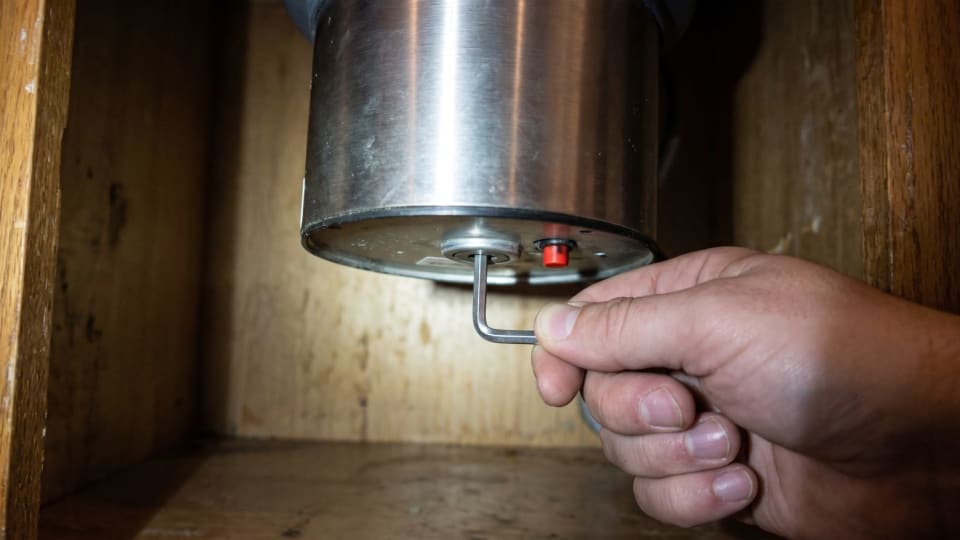
Hums but won’t spin: cut the power, then turn the hex socket on the bottom with a 1/4-inch Allen wrench to loosen the jam. Never reach into the chamber.
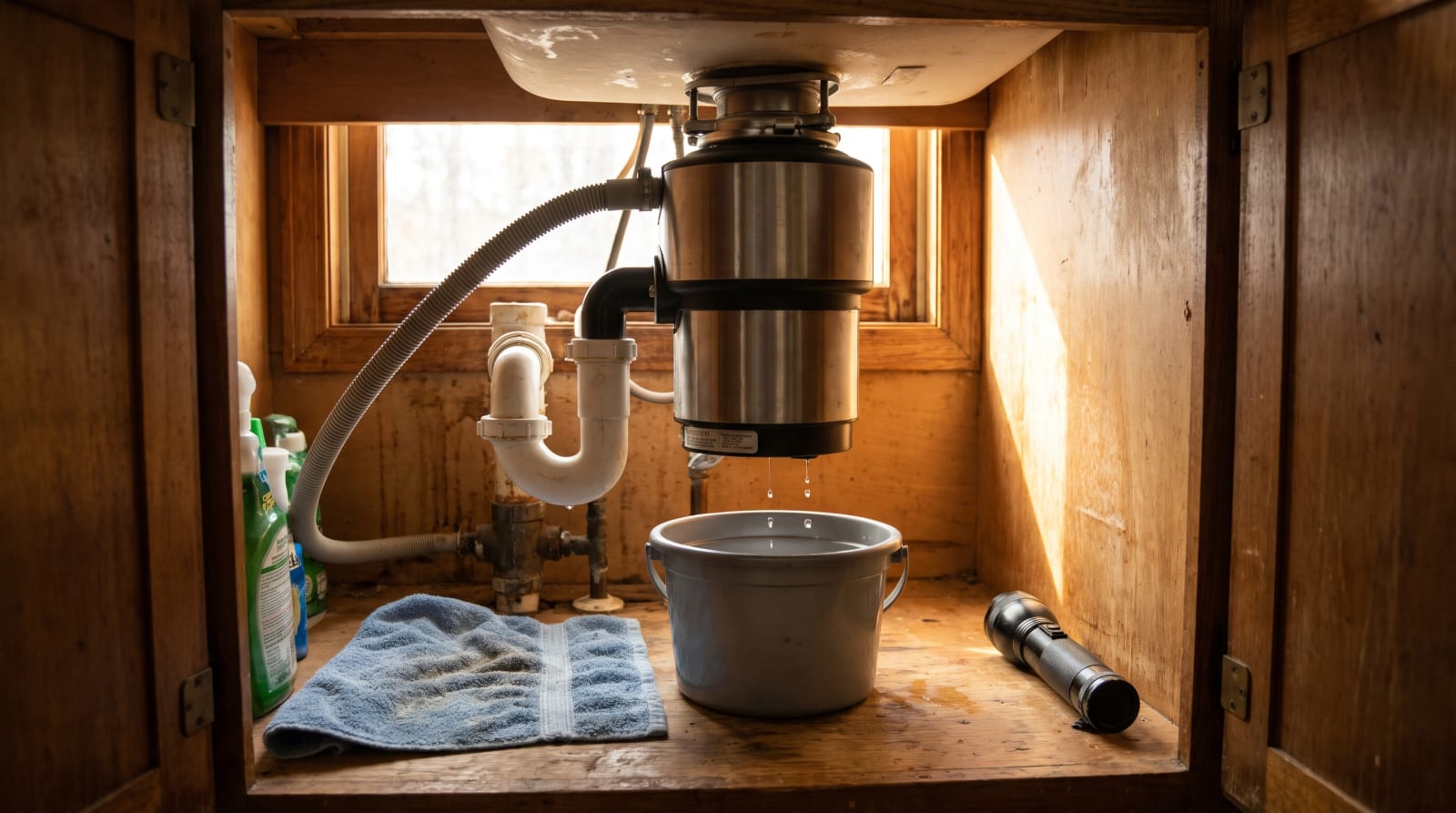
Leaking: find where the water comes from. Leaks at the top or side connections can usually be resealed; water dripping from the bottom of the unit usually points to replacement.
Call a plumber when a jam won’t clear, the reset keeps tripping, the body of the unit leaks, or both sinks back up.
Sources: InSinkErator installation, care & use manual, This Old House, U.S. EPA, City of Spokane · Checked: November 9, 2026
A garbage disposal tends to fail at the worst moment: right after a holiday dinner, with a sink full of water and a dishwasher waiting to drain. Most problems come down to a short list: no power, a jam, a leak, a slow or smelly drain, or a worn-out unit. Some are a five-minute fix. Others mean water is reaching places it shouldn’t, and it is time for garbage disposal and fixture repair in Spokane. This guide covers each symptom in the order a homeowner would check it, plus what Spokane’s sewer and septic systems mean for disposal use, repair vs. replacement and permits.
In this guide: How a disposal works · Troubleshooting by symptom · Won’t turn on · Hums but won’t spin · Leaks · Slow drains and smells · What can go down · Septic systems · Repair or replace · Permits and hiring · What affects the cost · Common questions · Quick summary
How a Garbage Disposal Works (and Why It Matters When It Breaks)
A disposal has no blades. According to This Old House, two stainless-steel lugs on a turntable spinning at about 1,725 rpm throw food against a grinding ring. That design explains most failures: a hard object wedged against the ring stops the motor, an overworked motor trips its overload, and the seals at the sink flange, discharge tube and dishwasher inlet wear over time. Source: This Old House – How to Repair a Garbage Disposal · Checked: November 9, 2026
Troubleshooting by Symptom
| Symptom | Most likely cause | What to check first | When to call a plumber |
|---|---|---|---|
| No sound at all | Tripped breaker, tripped reset button, loose plug or failed switch | Breaker, then the red reset button | Still dead after both resets |
| Hums but doesn’t spin | Something wedged between the turntable and grinding ring | Cut power, turn the hex socket on the bottom | It won’t turn, or jams again soon |
| Water under the sink | Loose flange, discharge gasket, dishwasher hose or a failed internal seal | Find the exact drip point | Water comes from the body or bottom of the unit |
| Slow drain or standing water | Food waste or grease in the trap or drain line | Run cold water longer after grinding | Both sinks back up, or the clog keeps returning |
| Bad smell | Food residue under the splash guard or in the chamber | Clean the splash guard and chamber | Smell persists, or other drains smell too |
Disposal Won’t Turn On
Silence usually means a power problem, not a dead motor. Check in this order:
- Check the plug and switch. Under-sink storage can knock a plug loose, and an air switch hose can slip off its fitting.
- Check the breaker or fuse. InSinkErator’s manual says that if the motor stays off, check the service panel for a tripped circuit breaker or blown fuse.
- Press the reset button. The manual’s instruction is to let the motor cool for 3 to 5 minutes, then lightly push the red reset button on the bottom of the disposal.
This Old House advises bringing in a licensed electrician if the breaker and the overload button don’t restore power. Source: InSinkErator – Badger Series Installation, Care & Use Manual (PDF); This Old House · Checked: November 9, 2026
Disposal Hums but Won’t Spin
A hum means the motor has power but can’t turn, because something is wedged in the chamber. Running it longer only heats the motor until the overload trips.
- Switch it off and cut the power at the plug or the breaker.
- Insert the wrench into the hex socket in the center of the unit’s bottom, as InSinkErator’s manual describes; This Old House notes a 1/4-inch Allen wrench works if the original is missing.
- Work it back and forth, counterclockwise then clockwise, until it turns a full circle smoothly.
- Remove the object with tongs or pliers. Hands stay out of the chamber.
- Restore power, press the reset button and test with cold water running.
If the turntable won’t budge, or the unit jams again with normal use, stop there: forcing it can break the socket or shaft. That is the point to call a plumber.
Garbage Disposal Leaking? Where the Water Comes From Matters
Water runs down the outside of the unit and drips from its lowest point, which isn’t always where the leak starts. InSinkErator’s support guidance suggests taping newspaper across the emptied cabinet floor, then filling and draining the sink and running the disposal while watching for wet spots. If the paper stays dry for a few days, the water may come from a faucet, sprayer, filter or countertop seam instead. Source: InSinkErator – Garbage Disposal Leaking at the Dishwasher Inlet (support page) · Checked: November 9, 2026
| Where it leaks | Usual cause | Typical fix |
|---|---|---|
| Top, where the disposal meets the sink | Loose mounting assembly or failed seal at the sink flange | Tighten the mounting ring or reseal the flange |
| Side, at the dishwasher inlet | Loose hose clamp, worn hose or adapter | Tighten clamps or replace the hose |
| Side, at the discharge tube | Worn gasket or loose flange bolts at the elbow | Replace the gasket and retighten |
| Bottom or body of the unit | Worn internal seals or a cracked housing | Usually replacement of the disposal |
Any leak that soaks the cabinet floor is worth acting on soon, since moisture under a sink can go unnoticed for weeks. For water that turns up elsewhere, see How to Check Your Home for a Hidden Water Leak.
Slow Drains, Backups and Bad Smells
Use cold water, and plenty of it. InSinkErator’s manual says to turn on cold water first, then the disposer, not to use hot water when grinding, and to keep cold water running for several seconds after grinding to flush the drain line.
Smells usually start under the splash guard. This Old House recommends scrubbing the chamber and the underside of the rubber guard, and scouring with baking soda and vinegar, or ice with a little rock salt. If the odor returns quickly or other drains smell too, the problem is further down the line.
Dishwasher won’t drain after a new disposal? InSinkErator’s manual explains that the dishwasher inlet is sealed with a knockout plug that must be removed before the hose is connected; otherwise the dishwasher may overflow. Source: InSinkErator – Installation, Care & Use Manual; This Old House · Checked: November 9, 2026
When both sides of a double sink back up or the clog returns within days, the blockage is usually in the trap or the drain behind the wall. That’s a job for drain cleaning in Spokane; Why Does My Drain Keep Clogging? explains the warning signs that point further down the line.
What Can and Can’t Go Down a Disposal
InSinkErator’s manual says never to pour grease or fat down a disposer or any drain, to avoid large amounts of eggshells and fibrous scraps such as corn husks and artichokes, and to keep clam or oyster shells and caustic drain cleaners out entirely. It lists small bones, fruit pits and ice as hard materials the unit can grind.
The City of Spokane’s fats, oils and grease brochure gives four household habits: scrape leftover food into the garbage before washing, place screens on sink drains, wipe kitchenware with a dry paper towel, and drain cooking grease into a sealable container that goes in the garbage once it is full and solid. A disposal that handles small scraps, not whole plates of leftovers, keeps the drain line clearer. Source: City of Spokane – Fats, Oils and Grease brochure (PDF); InSinkErator manual · Checked: November 9, 2026
Garbage Disposals and Septic Systems
Many Spokane County homes outside sewer service rely on septic. The U.S. EPA advises septic owners to eliminate or limit use of a garbage disposal: food waste adds solids that build up as scum and sludge, so the tank needs pumping more often. The EPA says household tanks are typically pumped every three to five years. Source: U.S. EPA – How to Care for Your Septic System · Checked: November 9, 2026
Repair or Replace the Disposal?
| Usually repairable | Usually time to replace |
|---|---|
| A jam that clears with the hex wrench | Water leaking from the body or bottom of the unit |
| A tripped reset button or breaker | A motor that hums or stays silent after resets and clearing |
| A leak at the sink flange, discharge gasket or dishwasher hose | Frequent jams with normal use on an older unit |
| Odors from residue under the splash guard | Grinding noise or burning smell with nothing in the chamber |
Check the model label on the unit first: a recent disposal may still be under the manufacturer’s warranty. This Old House suggests an upgrade when a disposal frequently jams or is old, pointing to anti-jam designs, more horsepower and better sound insulation.
Installation has more to it than it looks. InSinkErator’s manual says the unit must be grounded, wiring must comply with local electrical codes, and the drain line must slope at least 1/4 inch per foot; installations that don’t follow its instructions or local codes are excluded from its warranty. That’s why many homeowners have a plumber handle the swap, especially with a hardwired unit or a drain that needs rework. Source: InSinkErator – Installation, Care & Use Manual; This Old House · Checked: November 9, 2026
Video from This Old House: how a garbage disposal is installed, including the mounting ring, discharge tube and dishwasher connection:
Permits and Hiring in Spokane
The City of Spokane’s plumbing permit application lists garbage disposals as a fixture category, so ask whether a permit applies before a replacement. A permit fee applies; check with the City for current details. Homes in Spokane Valley or unincorporated Spokane County go through their own permitting offices. Source: City of Spokane – Plumbing Permit Application (PDF) · Checked: November 9, 2026
Before work starts, check the business with Washington L&I, whose Verify tool shows whether a business holds an active contractor registration and whether a person doing plumbing work holds a Washington plumber certification. Source: Washington L&I – Verify a Contractor, Tradesperson or Business · Checked: November 9, 2026
What Affects the Cost of Disposal Repair or Replacement
- Repair or replacement: clearing a jam or resealing a connection is a smaller job than installing a new unit.
- The new unit: motor size, noise insulation and features, and whether the homeowner or the plumber supplies it.
- Electrical setup: a hardwired unit or a missing outlet or ground adds work.
- Connections: an old trap, poorly sloped drain or worn dishwasher hose may need replacing too.
- What’s found: a deeper clog or water damage in the cabinet.
- Haul-away and permit: removing the old unit and, where it applies, the permit.
Ask whether the estimate covers a worn trap, hose or valve. A written, itemized estimate is the only reliable figure.
Common Questions
Why does a garbage disposal keep tripping its reset button?
The reset button cuts power when the motor overheats. Repeated tripping usually means a partial jam, overloading or a worn motor. Grind smaller amounts with plenty of cold water, and call a plumber if it keeps tripping under light use.
Can a chemical drain cleaner be used in a garbage disposal?
No. InSinkErator’s manual lists caustic drain cleaners among the things not to put in a disposer. A slow disposal drain is usually clogged in the trap or drain line, which a plumber clears mechanically.
Should a disposal run with hot or cold water?
Cold, before, during and for several seconds after grinding, according to InSinkErator’s manual, which advises against hot water while grinding.
Why won’t the dishwasher drain after a new disposal was installed?
The most common reason is the knockout plug in the disposal’s dishwasher inlet. InSinkErator’s manual says it must be removed before the dishwasher hose is connected; otherwise the dishwasher may overflow.
Does replacing a garbage disposal need a permit in Spokane?
The City of Spokane’s plumbing permit application includes garbage disposals as a fixture category. Ask the plumber or the City’s permit staff; homes outside city limits use a different permitting office.
Quick Summary
- No power: breaker first, then the red reset button after the motor cools.
- Humming: power off, hex wrench in the bottom socket, hands out.
- Leaks: top and side connections can usually be resealed; a body leak usually means replacement.
- Cold water while grinding; no grease, fibrous scraps or caustic drain cleaners.
- On septic, limit or skip the disposal (EPA).
- Call a plumber for stubborn jams, repeat tripping, body leaks or backups in both sinks.
Garbage Disposal Trouble in Spokane?
One call connects to an independent, local plumbing provider serving Spokane and Spokane Valley for jammed, leaking and worn-out garbage disposals, plus sink and drain connections.
📞 Call Now – Connect With a Spokane Plumber
Spokane Home Help is a referral service, not a plumbing contractor.
Related Articles
- Garbage Disposal & Fixture Repair in Spokane
- Why Does My Drain Keep Clogging?
- How to Check Your Home for a Hidden Water Leak
Spokane Home Help is a referral service and is not a plumbing contractor. Calls may be connected to an independent, third-party plumbing provider serving the caller’s area. Spokane Home Help does not perform plumbing work and is not responsible for the work, pricing, licensing or availability of any provider. Before work begins, confirm the provider’s Washington L&I registration and ask for a written estimate.