
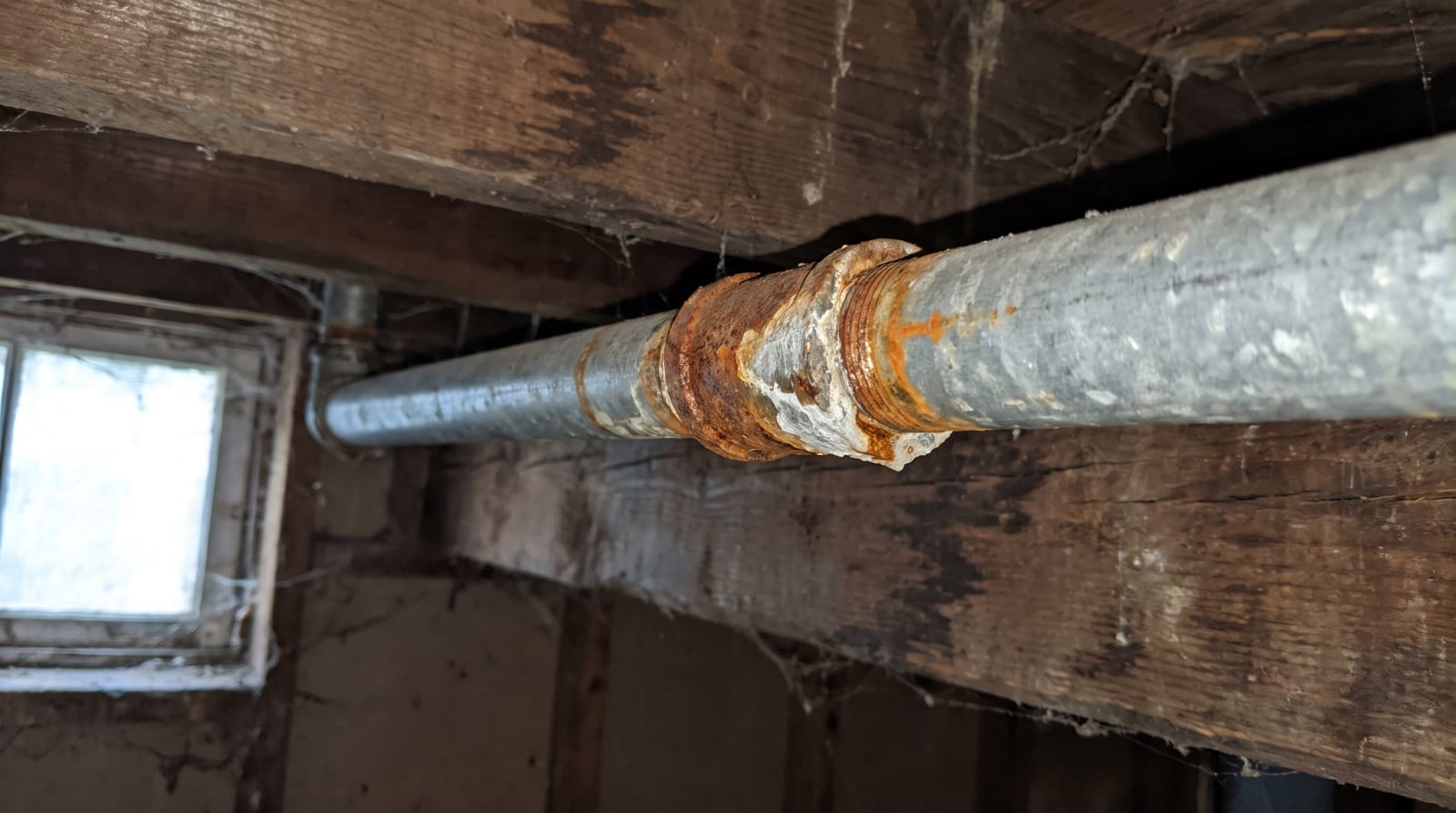
The Short Answer
How to tell: galvanized supply pipe is dull gray steel with threaded joints, and a magnet sticks to it. Copper, PEX and lead pipe will not hold a magnet.
Why it matters: once the zinc coating wears away, the steel rusts from the inside, flow drops, water turns brown and leaks follow.
Lead: galvanized pipe that was ever connected downstream of a lead line can hold lead in its scale. Testing the water is the only way to know.
Call a plumber when leaks keep appearing in different places, flow is weak at several fixtures, or the water stays discolored.
Sources: EBMUD, City of Spokane, U.S. EPA, This Old House · Checked: November 9, 2026
Many Spokane houses were plumbed long before plastic and copper supply lines became the norm, and in neighborhoods such as the South Hill, Hillyard, Browne’s Addition and the older parts of Spokane Valley, gray threaded steel pipe still turns up behind basement walls and under crawl spaces. It can work for decades, but it fails gradually: weaker showers, rusty water first thing in the morning, then a pinhole leak, then another. When that pattern shows up, the conversation turns to repiping a Spokane home. This guide covers how to identify galvanized pipe, how it ages, the lead question, and how to choose between a spot repair, a partial repipe and a whole-house replacement.
In this guide: What galvanized pipe is · How to identify it · How it fails · Lead in Spokane · Steel-to-copper joints · Repair or repipe · The service line · Buying an older home · Replacement materials · Cost factors · Permits · Common questions
What Galvanized Pipe Is and Why Older Homes Have It
Galvanized pipe is iron or steel pipe dipped in a protective zinc coating. East Bay Municipal Utility District (EBMUD), a public water utility, explains that galvanized pipe was commonly used for drinking water before the 1960s and is not generally used for it today. The zinc is sacrificial: it corrodes first to protect the steel underneath, and once it is gone, the iron begins to corrode. This Old House puts it the same way, noting that galvanized steel is no longer used for supplying water and that, as plumbing expert Richard Trethewey says, it “would rust from the inside.” Source: EBMUD – Galvanized Iron Pipes; This Old House – How to Choose Water Supply Piping · Checked: November 9, 2026
How to Tell if a House Has Galvanized Pipes
Start where pipe is exposed: at the main shutoff valve where the water line enters the basement or crawl space (see how to find the main water valve), at the water heater connections, under sinks, and along basement ceilings. EBMUD’s simplest test is a magnet: a magnet sticks only to iron and steel pipe, while copper, plastic and lead will not hold one. Source: EBMUD – Galvanized Iron Pipes · Checked: November 9, 2026
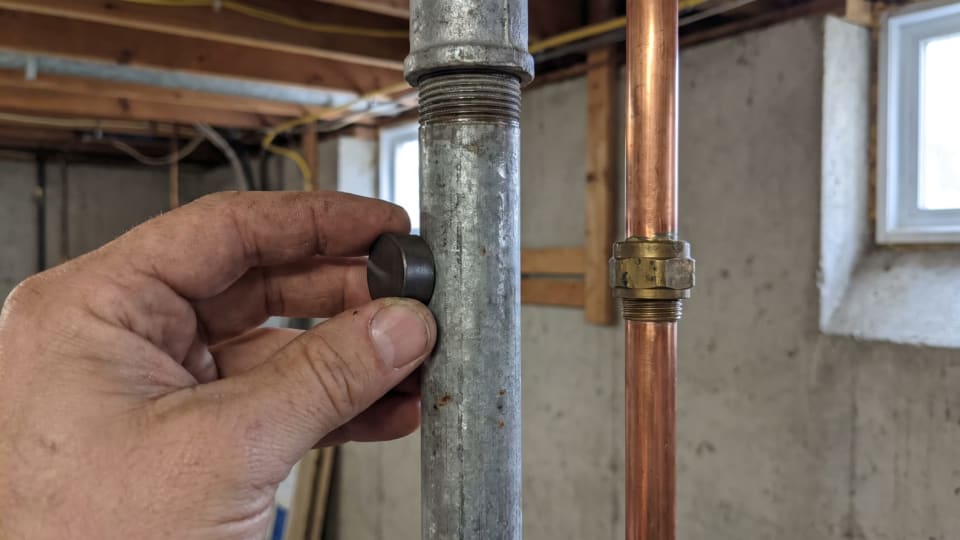
| Pipe material | What it looks like | Magnet? | How joints are made |
|---|---|---|---|
| Galvanized steel | Dull gray or silver metal, often with rust spots at the joints | Sticks | Threaded fittings screwed together |
| Copper | Reddish-brown metal, may turn green or dark with age | Does not stick | Soldered, compression or press fittings |
| PEX | Flexible plastic tubing, often red for hot and blue for cold | Does not stick | Crimp rings or expansion fittings |
| Polybutylene | Usually gray plastic, often stamped “PB2110” | Does not stick | Crimp rings or plastic fittings |
| Lead | Dull gray metal; in Spokane mainly found on old service lines, which the City has replaced in its system | Does not stick | Have a plumber confirm the material |
Source: EBMUD – Galvanized Iron Pipes; This Old House – How to Choose Water Supply Piping · Checked: November 9, 2026
Many older homes are a mix: visible basement runs replaced with copper or PEX, original steel still inside the walls or underground. Check every exposed section, not just one spot.
How Galvanized Pipes Fail
EBMUD describes the process in three stages: once the coating is gone, the iron rusts, corrosion deposits build up inside the pipe, and the pipe eventually leaks. It adds that iron pipe does not corrode evenly; discrete mounds called tubercles form inside and can block water flow. Old, corroded galvanized pipe, EBMUD notes, can cause low water pressure and discolored water. Source: EBMUD – Galvanized Iron Pipes · Checked: November 9, 2026
| What the homeowner notices | What it often points to | Sensible next step |
|---|---|---|
| Brown or yellow water at the first draw that clears after running | Rust loosening from the inside of old pipe | Note which taps do it, hot or cold side, and have the pipes checked |
| Weak flow at several fixtures, worse when two run at once | Deposits narrowing the pipe | Ask a plumber to test flow, not just static pressure |
| Weak flow at one faucet only | A clogged aerator or cartridge, often from rust flakes | Clean the aerator first; it may be a small fix |
| Pinhole leaks or a weeping threaded joint | Pipe walls or joints wearing through | Repair now, and ask how much of the system is the same age |
| Water stains on a ceiling or wall | A hidden leak in a pipe inside the wall | See leak detection in Spokane |
Discolored water, weak flow across the house and repeated leaks together are the strongest signal that the system is near the end of its service life. If a pipe is spraying, close the main valve and follow what to do when a pipe bursts.
Galvanized Pipe and Lead: What Spokane Homeowners Should Know
Galvanized pipe is not lead pipe, but the two can be connected. EBMUD explains that the zinc coating can contain contaminants such as lead and cadmium, and that where a lead pipe was attached upstream, scale containing lead can form on the inside walls of galvanized pipe. The U.S. Environmental Protection Agency (EPA) calls a galvanized line that is or ever was downstream of a lead service line “galvanized requiring replacement” (GRR), and its model notice to residents states that galvanized service lines that have adsorbed lead can contribute to lead in drinking water. Source: EBMUD – Galvanized Iron Pipes; U.S. EPA – Notice of Galvanized Requiring Replacement Service Line (PDF) · Checked: November 9, 2026
In Spokane, the City says it has no lead pipes within its water system. Its lead service lines dated from the early to mid-1940s, many in the Shadle area, and the last 486 were replaced with copper in July 2018. Under EPA rules, the City mailed notices to about 1,000 property owners whose galvanized connections could have been attached to lead pipe before 2018. The City adds that its aquifer water is hard and not acidic, making it less corrosive than most surface water. Source: City of Spokane – Lead Pipes · Checked: November 9, 2026
Where Old Steel Meets New Copper: Why the Connection Matters
Partial repairs often leave copper joined to galvanized steel. This Old House explains that when dissimilar metals touch in water, a tiny electric current moves material from one to the other (electrolysis), deteriorating one of them and leading to leaks. The usual answer is a dielectric union, with a nonconductive gasket between the copper and steel sides that breaks the electrical connection. Source: This Old House – How to Join Steel and Copper Pipes · Checked: November 9, 2026
Repair, Partial Repipe or Whole-House Replacement?
EBMUD notes that galvanized pipe can last many years, but eventually the zinc coating will be gone. There is no fixed age at which it must come out; condition decides. These are the usual options and when each tends to fit:
| Option | When it tends to make sense | Keep in mind |
|---|---|---|
| Spot repair | One leak at one joint, flow and color otherwise fine | Old pipe next to the repair is the same age |
| Partial repipe | One problem area, such as the basement trunk line or one bathroom | Remaining branches keep aging; transitions need proper fittings |
| Whole-house repipe | Leaks in several places, weak flow throughout, recurring discolored water | The largest project, but it resets the supply system at once |
| Service line replacement | Weak flow everywhere, even at the first fixture inside the house, or a leak in the yard | A separate buried line; see water line repair in Spokane |
Source: EBMUD – Galvanized Iron Pipes · Checked: November 9, 2026
Timing matters too. A kitchen or bathroom remodel opens walls anyway, which is the easiest moment to replace the pipe inside them. And in Spokane, a repipe is a chance to move supply lines out of exterior walls and cold crawl-space runs that tend to freeze; see how to prevent frozen pipes in Spokane for where the risk is highest.
Don’t Forget the Buried Service Line
The City of Spokane defines a service line as the connection from the main in the street to the water meter. Beyond the meter, another line carries water into the house, and in older homes it may also be galvanized. If flow is weak even at the first fixture inside, the problem may be underground. Responsibility for each section differs by utility, so confirm with the Water Department or the utility on the bill. See water line repair vs. replacement. Source: City of Spokane – Lead Pipes · Checked: November 9, 2026
Buying or Owning an Older Spokane Home With Galvanized Pipe
- Test flow, not just pressure. Run the kitchen tap and a tub together, then check the highest shower in the house.
- Look for patch repairs. Clamps, short copper or PEX splices and stained joints show where leaks have already happened.
- Check the water heater connections for rust and mineral crust; see water heater repair in Spokane.
- Ask about the service line and whether a City notice about a galvanized line was received.
- Ask the home insurer whether the pipe material affects coverage.
- Watch for hidden leaks. A meter that moves with every fixture off can reveal one; see how to check for a hidden water leak.
What Replaces Galvanized Pipe
This Old House describes the common replacements. Copper is the most widely used supply pipe; Type L has thick walls and Type M thin walls, and local code decides which is allowed. PEX is flexible tubing, red for hot and blue for cold, joined with crimp or expansion fittings, and it can snake through walls with fewer openings. CPVC is a rigid plastic rated for water supply (plain PVC is rated only for drainage). Ask the plumber why a material is recommended for this particular house. Source: This Old House – How to Choose Water Supply Piping · Checked: November 9, 2026
What Affects the Cost of Replacing Galvanized Pipe
- Scope: one trunk line, one bathroom or the whole house.
- Size and layout: bathrooms, fixtures and floors.
- Access: open basement or crawl space versus finished walls.
- Material: PEX, copper or CPVC.
- Service line: whether the buried line is included.
- Valves and water heater connections replaced at the same time.
- Wall repair: included or handled separately.
- Permit: a permit fee applies where a permit is required; check with the City.
- Hidden damage found once walls are open.
A written, itemized estimate is the only reliable figure. Ask that it spell out scope, material, transitions to any pipe staying in place, permits and wall repair.
Permits and Who Can Do the Work
Washington L&I states that only L&I-certified plumbers can legally perform plumbing work on someone else’s property, and that property owners can perform their own plumbing work on properties they own. Permit rules still apply to owner work: homes inside Spokane city limits go through the City, while Spokane Valley and unincorporated Spokane County have their own permitting offices. Before hiring, the L&I Verify tool shows whether a business is registered and the worker holds a plumber certification. Source: Washington L&I – About the Plumber Certification Program · Checked: November 9, 2026
Video from Ask This Old House: plumbing expert Richard Trethewey walks through fittings that join pipe without soldering, the kind of connections often used when new lines are tied into an existing system:
Common Questions
How long do galvanized pipes last?
There is no single number. EBMUD says galvanized pipe can last many years, but eventually the zinc coating is gone and the steel corrodes. Condition matters more than age.
Can old galvanized pipes be cleaned out instead of replaced?
Cleaning aerators helps with grit at the fixture, but the deposits inside the pipe are part of the corroded pipe wall. Any proposal to descale or flush old steel lines is worth discussing carefully with a licensed plumber first.
Is water from galvanized pipes safe to drink?
Lead is the real question. EBMUD advises testing the water to know for sure, and the EPA recommends cold water only for drinking and cooking, plus flushing the tap, until results are in.
Will replacing galvanized pipe fix low water pressure?
When narrowed galvanized lines are the cause, new pipe usually restores flow. But weak flow everywhere can also come from the buried service line or a partly closed main valve, so confirm the cause first.
Can a homeowner replace galvanized pipe in Washington?
Washington L&I allows owners to do their own plumbing on property they own; permits and inspections still apply. Brittle old steel, hidden runs and main-line tie-ins make whole-house work a job most owners hand to a plumber.
Quick Summary
- Galvanized pipe is gray, threaded steel; a magnet sticks to it.
- It corrodes from the inside: weak flow, rusty water, then leaks.
- Galvanized pipe once connected to lead can hold lead in its scale; only a water test can tell.
- One leak may need a spot repair; leaks, weak flow and discolored water together point to a partial or whole-house repipe.
Old Galvanized Pipes in a Spokane Home?
One call connects to an independent, local plumbing provider serving Spokane and Spokane Valley for galvanized pipe assessments, repiping and recurring supply-line leaks.
📞 Call Now – Connect With a Spokane Plumber
Spokane Home Help is a referral service, not a plumbing contractor.
Related Articles
- Repiping in Spokane
- Water Line Repair vs. Replacement: A Spokane Homeowner’s Guide
- How to Check Your Home for a Hidden Water Leak
Spokane Home Help is a referral service and is not a plumbing contractor. Calls may be connected to an independent, third-party plumbing provider serving the caller’s area. Spokane Home Help does not perform plumbing work and is not responsible for the work, pricing, licensing or availability of any provider. Before work begins, confirm the provider’s Washington L&I registration and ask for a written estimate.