
The Short Answer
No one-size price: the cost of a replacement depends on the heater type, fuel, size, code items and access. A written, itemized estimate is the only reliable figure for a specific home.
What moves the price: tank vs. tankless, gas vs. electric, tank size, code items such as an expansion tank and seismic straps, how hard the unit is to reach, and permits and haul-away.
Repair or replace: a leaking valve or fitting can often be repaired; a corroded, leaking tank means replacement.
Permits: the City of Spokane lists gas and electric water heaters on its mechanical permit application, so ask whether the permit is included in any estimate.
Sources: NerdWallet, Angi, City of Spokane, WA Dept. of Labor & Industries, This Old House · Checked: November 7, 2026
When a water heater quits in the middle of a Spokane winter, or a puddle appears around the base of the tank, the first question is usually how much a replacement will cost. The honest answer: it depends on the type of heater, the fuel, the size and what the installation needs to meet current code. This guide walks through what goes into a replacement estimate, the factors that push the price up or down, how to decide between repair and replacement, and what to ask before any work begins.
In this guide: What goes into an estimate · What affects the price · Permits in Spokane and Washington · Repair or replace · Questions to ask · Video · Common questions
What Goes Into a Water Heater Replacement Estimate
National cost guides from NerdWallet and Angi break a water heater replacement into the same main parts: the new unit, installation labor, code-required parts, the permit and removal of the old heater. Tankless installations generally involve more labor than a like-for-like tank swap, and switching from a tank to tankless adds the most. The only reliable number for a specific home is a written, itemized estimate. Source: NerdWallet – Water Heater Cost; Angi – Water Heater Replacement Cost · Checked: November 7, 2026
| Estimate line item | What it covers | Why it varies |
|---|---|---|
| The new water heater | Tank or tankless unit | Type, fuel, size and efficiency |
| Installation labor | Draining, removing and connecting | Access, location, tank vs. tankless |
| Switching tank to tankless | Venting, gas line or electrical changes | What the home already has in place |
| Code items | Expansion tank, seismic straps, T&P relief line, shutoff valve | What the existing installation is missing |
| Permit | City or county permit and inspection | Jurisdiction and type of work |
| Haul-away | Removal and disposal of the old unit | Whether it’s included or listed separately |
Line items commonly listed in national cost guides; what applies depends on the specific job. Source: NerdWallet; Angi · Checked: November 7, 2026
What Affects the Price
1. Tank vs. tankless
Swapping an old tank for a similar new tank is the simplest job. Tankless installations cost more in labor, and switching from a tank to tankless can add significant extra labor for venting, gas line or electrical changes. NerdWallet notes that a well-maintained tank lasts about 10 to 15 years, while a tankless model can last 20 years or longer. For a side-by-side comparison, see Tank vs. Tankless Water Heaters for Spokane Homes. Source: NerdWallet · Checked: November 7, 2026
2. Gas vs. electric
For tank models, NerdWallet reports that electric, propane and natural gas units have similar starting price points. For tankless units, gas models generally cost significantly more than electric ones. Gas installations also involve venting, combustion air and gas connection requirements that electric units don’t. Source: NerdWallet; MyBuildingPermit.com – Water Heater Tip Sheet · Checked: November 7, 2026
3. Tank size
Bigger tanks cost more. NerdWallet’s figures show the unit price rising with each step up, from 40 to 50 to 75–80 gallons, before installation. A larger tank may also not fit in the same closet or alcove. Source: NerdWallet · Checked: November 7, 2026

4. Code items: expansion tank, seismic straps and more
A replacement is expected to meet current code, which can add parts and time. A Washington construction tip sheet from MyBuildingPermit.com, based on the state amendments to the plumbing and residential codes, lists items such as:
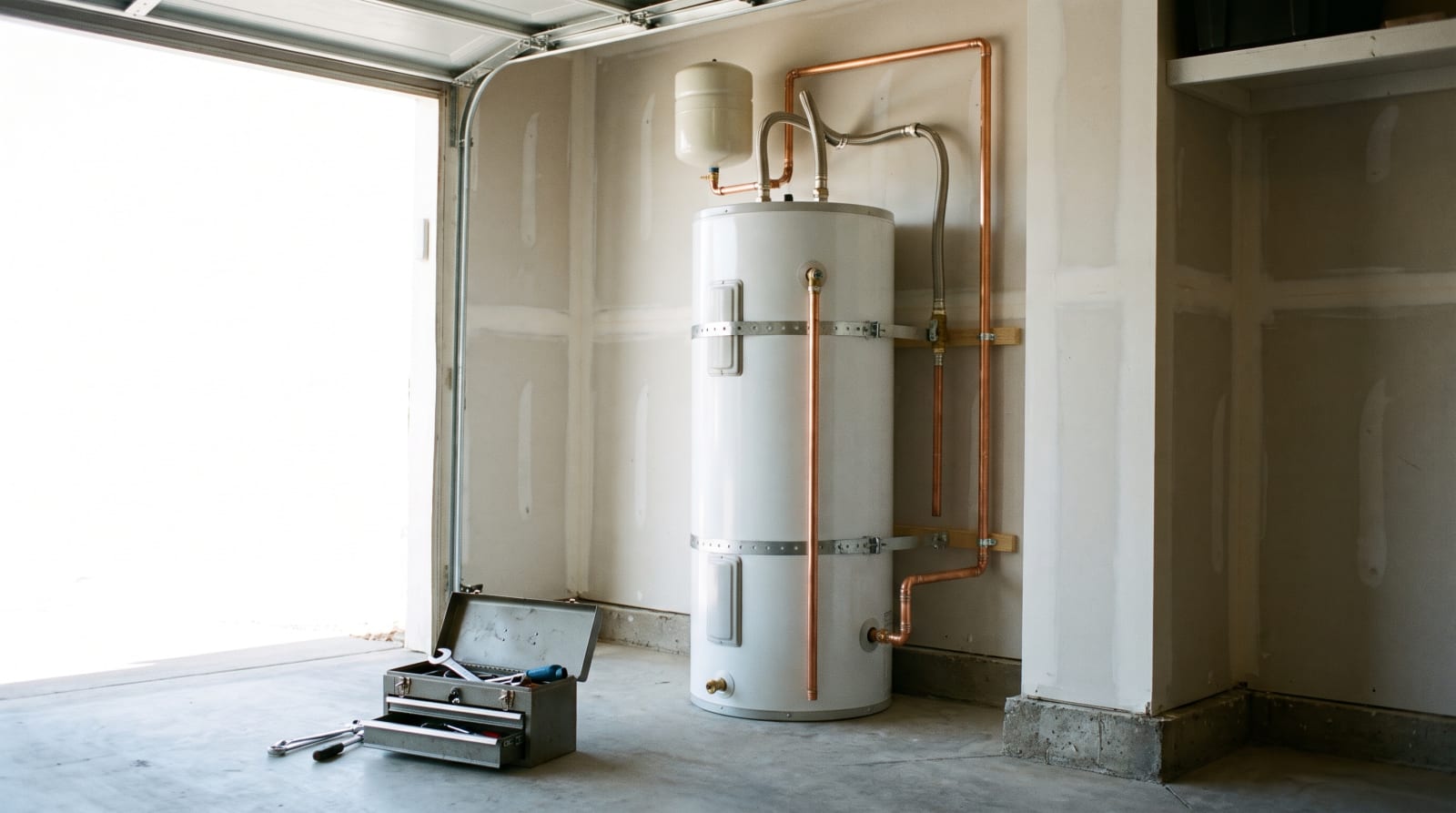
- Seismic strapping in the upper and lower thirds of the tank, at least 4 inches above the controls. Perforated plumber’s tape is not an acceptable strap.
- A thermal expansion tank on a closed plumbing system.
- A ¾-inch temperature and pressure (T&P) relief line routed to an approved location.
- A shutoff valve on the incoming cold-water line.
- For gas units: combustion air, vent clearances, a gas shutoff and a sediment trap.
Local requirements can differ, so the inspector for the home’s jurisdiction has the final word. Depending on the location of the heater, a drain pan may also be part of the job; ask whether one is needed. Source: MyBuildingPermit.com – Construction Tip Sheet 07: Water Heaters · Checked: November 7, 2026
5. Access and location
A heater in an open garage or basement is easier to swap than one in a tight closet, attic or crawl space. Moving the heater to a new location is a separate, larger job; Angi lists relocation as its own cost item. Source: Angi · Checked: November 7, 2026
6. Permits and haul-away
Permit fees and removal of the old unit are easy to overlook. Both appear as separate line items in national cost guides (see the table above), so check whether an estimate includes them.
Permits for Water Heaters in Spokane and Washington
The City of Spokane’s mechanical permit application lists gas water heaters and electric water heaters (under 200,000 BTU input) as permit fee items. Homes in Spokane Valley fall under that city’s rules; Spokane Valley lists the replacement of mechanical and plumbing fixtures and appliances as work requiring a mechanical or plumbing permit. Source: City of Spokane – Mechanical Permit Application; City of Spokane Valley – Mechanical/Plumbing Permits · Checked: November 7, 2026
For electric units, the Washington State Department of Labor & Industries (L&I) explains that installing a new hard-wired appliance requires an electrical permit and inspection, and that a homeowner may do the work on their own property; otherwise a contractor is required. L&I also notes that equipment connecting to water, sewer or gas systems may need additional permits and inspections from the local building department. Source: WA L&I – Appliance Installation & Repair · Checked: November 7, 2026
Repair or Replace?
Not every leak or failure means a new heater. This Old House notes that a leaky drain valve generally just needs a new valve, a faulty T&P valve can be replaced on its own, and leaks at connection points are sometimes as simple as a loose fitting. Replacement usually makes more sense when:
- The tank itself is corroded and leaking. This Old House is direct: if the tank is corroded, the only solution is to replace the entire water heater.
- The heater is more than 10 years old.
- There’s rust in the hot water, on the outside of the tank, or small puddles at the base.
- Repairs are becoming frequent on an older unit.
Source: This Old House – How to Diagnose and Repair a Leaking Water Heater · Checked: November 7, 2026
For first steps when water is on the floor, see Water Heater Leaking: What to Do. Common warning signs are also covered on the water heater repair in Spokane page.
Questions to Ask Before Work Begins
- Is the contractor registered with Washington L&I? (Registration can be checked on the L&I website.)
- Is the estimate written and itemized?
- Does it include the permit, code items such as an expansion tank and seismic straps, and haul-away of the old unit?
- What warranty comes with the unit, and what labor warranty does the installer offer?
- For a switch to tankless: what venting, gas line or electrical changes are needed?
- How long will the home be without hot water?
Video from Ask This Old House: how a tank-type water heater is replaced, from draining the old unit to connecting the new one:
Common Questions
How much does it cost to replace a water heater in Spokane?
There’s no single price. It depends on the unit, the fuel, the size, code items, access, the permit and haul-away, so a written, itemized estimate is the only reliable figure. Comparing two estimates line by line is the easiest way to see what each one includes.
Is a permit needed to replace a water heater in Spokane?
The City of Spokane lists gas and electric water heaters on its mechanical permit application, and L&I notes that electrical permits and other local permits may apply. Confirm with the City of Spokane (or Spokane Valley, or Spokane County for unincorporated areas) and ask whether the estimate includes the permit.
How long does a water heater last?
According to NerdWallet, a properly maintained tank water heater lasts about 10 to 15 years, and a tankless model can last 20 years or longer.
Why is an expansion tank on the estimate?
Washington code guidance calls for a thermal expansion tank on a closed plumbing system, so many replacements add one. National cost guides list it as its own line item.
Quick Summary
- An estimate is built from the unit, labor, code items, the permit and haul-away.
- Price drivers: tank vs. tankless, gas vs. electric, size, code items, access, permits and haul-away.
- Code items in Washington can include seismic straps, an expansion tank and a proper T&P relief line.
- The City of Spokane lists water heaters on its mechanical permit application.
- Valves and fittings can often be repaired; a corroded, leaking tank means replacement.
- Get a written, itemized estimate and confirm L&I registration before work begins.
Need a Water Heater Replaced in Spokane?
One call connects to an independent, local plumbing provider serving Spokane and Spokane Valley for water heater repair, replacement and installation.
📞 Call Now – Water Heater Help in Spokane
Spokane Home Help is a referral service, not a plumbing contractor.
Related Articles
- Tank vs. Tankless Water Heaters for Spokane Homes
- Water Heater Leaking: What to Do
- Plumbing Emergency or Can It Wait?
Spokane Home Help is a referral service and is not a plumbing contractor. Calls may be connected to an independent, third-party plumbing provider serving the caller’s area. Spokane Home Help does not perform plumbing work and is not responsible for the work, pricing, licensing or availability of any provider. Before work begins, confirm the provider’s Washington L&I registration and ask for a written estimate.